
Discover Neptune’s Grotto in Alghero: its history, the caves and chambers open to visitors, Lake La Marmora, interesting facts and useful tips for planning your visit. A complete guide.

Neptune’s Grotto in Alghero: Complete Guide to Visiting

300626
Caves of Alghero
Book now

do you want to save money?

Confirmation is immediate

PLEASE CHECK THE AVAILABILITY IN THE CALENDAR

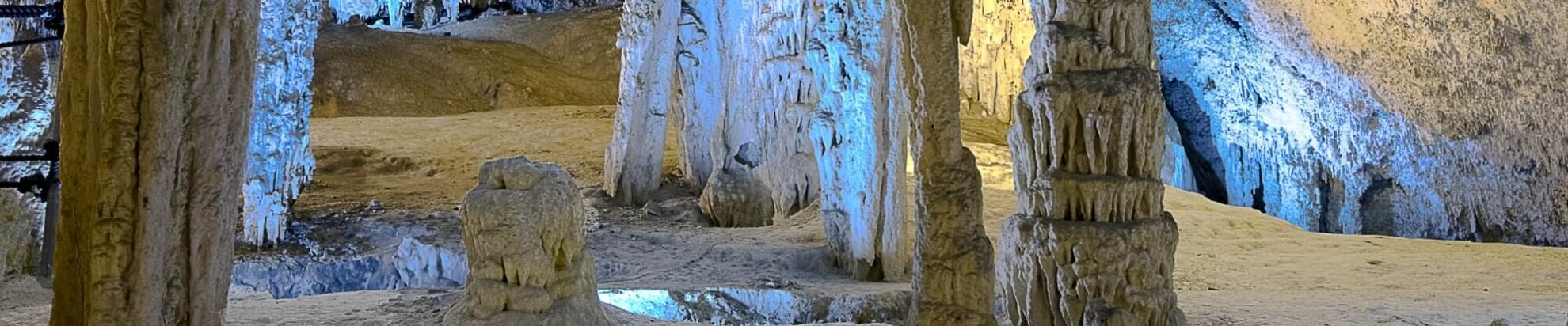
Neptune’s Grotto is one of the most fascinating places in Sardinia and one of Alghero’s main natural attractions. Located at the foot of the Capo Caccia promontory, this spectacular sea cave contains underground lakes, impressive chambers rich in limestone formations and a geological heritage that has developed over millions of years.

With a tourist route approximately one kilometre long, the visit allows you to discover some of the most spectacular underground environments in the Mediterranean, accompanied by experienced guides who explain the history and characteristics of the cave.

Would you like to know how to get there? Read our dedicated guide: How to Reach Neptune’s Grotto by Boat or on Foot.

The History of Neptune’s Grotto

The formation of Neptune’s Grotto dates back approximately two million years, when the slow action of water shaped the limestone massif of Capo Caccia, creating an intricate system of underground galleries and chambers.

The caves were already known in ancient times. Archaeological discoveries in the nearby caves of the promontory provide evidence of human presence since prehistoric times, while some scholars believe that the Romans were also aware of these underground environments.

The modern rediscovery of Neptune’s Grotto is traditionally attributed to a fisherman from Alghero in the 18th century.

What to See Inside Neptune’s Grotto

The route open to visitors takes approximately 40 minutes and allows you to explore some of the most fascinating areas of the cave.

Each chamber tells the story of millions of years of geological evolution through stalactites, stalagmites, limestone columns and pools of water that make this place truly unique.

The Most Spectacular Chambers of Neptune’s Grotto

Lake La Marmora

One of the first areas encountered during the visit is the fascinating Lake La Marmora, considered one of the largest underground saltwater lakes in Europe. Its waters, fed directly by the sea, reflect the cave’s ceilings and create spectacular plays of light that change depending on the natural and artificial lighting.

Along its shores lies the characteristic Spiaggia dei Ciottolini, a small stretch of pebbles smoothed by the water that makes this environment even more fascinating. It is one of the most photographed points of the visit and represents the gateway to Neptune’s Grotto.

The Reggia Chamber

Continuing along the route, you reach the Reggia Chamber, one of the largest and most spectacular areas of the cave. Here, nature has shaped enormous stalagmites and limestone columns over millions of years, appearing almost to support the cavern ceiling.

Among the best-known formations is the famous Christmas Tree, a concretion named for the distinctive shape it acquired through the slow deposition of calcium carbonate. The size of the chamber and the interplay of light create a truly atmospheric setting.

The Great Organ

Among the most spectacular formations in Neptune’s Grotto, the Great Organ deserves special mention. It is a gigantic calcite column formed by the joining of a stalactite and a stalagmite.

Its name comes from its resemblance to the pipes of a musical organ and it represents one of the most impressive examples of the slow work carried out by water over thousands of years. Looking at it up close, you can appreciate the different layers of calcite that reveal the cave’s long geological history.

The Lace and Embroidery Chamber

Among the most delicate areas of Neptune’s Grotto is the Lace and Embroidery Chamber, named for its extremely fine limestone formations that resemble lacework.

The walls appear to be decorated with natural lace, created drop by drop over an extraordinarily long period of time. It is one of the chambers that best demonstrates how fragile this environment is and how important it is to preserve it by avoiding any contact with the formations.

The Music Gallery

The visit ends in one of the cave’s most intriguing areas: the Music Gallery. This panoramic viewpoint overlooks Lake La Marmora and takes its name from the unusual acoustics that once made it possible to organise small concerts and performances inside the cave.

Today, it is one of the most atmospheric places along the entire route, where visitors can stop to admire the grandeur of the cave and understand how nature, water and time have created one of Sardinia’s most spectacular underground landscapes.

How Stalactites and Stalagmites Are Formed             

The spectacular formations found inside Neptune’s Grotto are the result of a natural process that takes an extraordinarily long time.

It can take approximately 300 years for just one centimetre of calcite to form.

For this reason, it is essential to follow the visitor guidelines and never touch the formations, many of which are still slowly growing today. 

Interesting Facts About Neptune’s Grotto

Neptune’s Grotto is not only an important natural attraction.

In 1978, it was used as a filming location for scenes from the movie L'isola degli uomini pesce, for which a small boat was even built and used during filming.

Every year, thousands of visitors reach the cave. To protect this delicate ecosystem, access is regulated and visits take place exclusively with a guide.

How Long Does the Visit Last?

The guided tour lasts approximately 40 minutes and follows a safe and easily accessible route.

Along the way, the guides explain the history of the cave, its geological formation and the characteristics of its main chambers.

How to Reach Neptune’s Grotto

Neptune’s Grotto can be reached in two ways:

For detailed information about access, reservations and practical tips, read our guide: How to Reach Neptune’s Grotto by Boat or on Foot.

Where to Stay When Visiting Neptune’s Grotto

If you are planning a holiday in Alghero, B&B Bonsai is an ideal base for visiting Neptune’s Grotto and the other wonders of the Coral Riviera.

We will be happy to recommend the best time to visit and provide useful information to help you organise your excursion.

Accessibility
close
Accessibility Information

Together with our selected providers, we are committed to ensuring that our services are accessible to people with disabilities. We devote significant resources to ensure that our website and room booking pages are easier to use and more accessible for individuals with disabilities, based on the strong belief that everyone has the right to live with dignity, equality, comfort, and independence.

Along with our partners, we continuously strive to improve the accessibility of our website and the pages for booking rooms and/or purchasing additional products and services related to the stay. We firmly believe it is our collective moral obligation to allow seamless, accessible, and unhindered use, even for those of us with disabilities.

In our ongoing efforts to improve and consistently address accessibility issues, we regularly scan all web pages using accessibility scanners provided by third-party commercial partners to identify and fix any potential accessibility barriers on our site. Despite our efforts to make all our web pages and content fully accessible, some content may not yet have been fully adapted to the strictest accessibility standards. This may be due to not having yet found or implemented the most appropriate technological solution.

Compliance Status

This website and the room booking pages are partially compliant with the technical standard for websites and mobile applications UNI CEI EN 301549, and with the “AA” accessibility level required by the Web Content Accessibility Guidelines (WCAG) 2.1.
In particular, the compliance level of this website is constantly monitored through the tools provided by:
https://mauve.isti.cnr.it/
https://pagespeed.web.dev/

Non-accessible Content

Despite our efforts to ensure the accessibility of the website and booking pages, we are aware of some limitations we are working to resolve. Below is a description of the known limitations. Please contact us if you encounter an issue not listed below.

  • Image text alternatives: Some images do not have meaningful text alternatives for users.
  • Reading order: Due to the modular structure of some pages, the reading order of elements may not match their visual order.
  • Focus contrast: In some cases, when elements receive focus, there may be insufficient contrast between text color and background.
  • Keyboard operability: Some components cannot be operated using only a keyboard.
  • Animated content: Some pages contain animated content that cannot be paused or hidden.
  • Focus visibility: In some pages, the element with active focus is not visually identifiable.
  • Language accessibility: Some elements display text or accessible names only in certain languages.
  • Assistive technology: Assistive technologies may not always correctly announce messages.

Last Updated

This page on accessibility was last updated on June 25, 2025.